When backs are better than fronts – 5

Continuing the series, this is what you’ll see if you visit the Briner company, at least if you don’t fall asleep first, because in this industrial part of the Swiss city of Winterthur each building tries to outdo its neighbors in achieving the greatest architectural boredom:

But, if you don’t mind a bit of adventure you can walk around to the back of the building, where the building sits next to a railroad spur, and your eyeballs will explode when you see the amazing graffiti:

I didn’t want to photograph each artwork in detail, but I did want to provide at least one snap so you can see the amazing quality:

The amazing underground recycling cisterns of Switzerland

I’ve written about garbage in Texas and garbage in Switzerland.  I’ve also written about garbage in Germany.

So as long I was in a garbage state of mine, I wanted to finish by showing a very common sight in the Swiss canton of Zurich: a long row of very nice looking, very pretty smelling chutes:

They make it just about as easy and convenient as possible for residents to drive here and empty their recyclables into the appropriate chute.  From time to time, a truck will arrive, and a single driver / operator is all that is needed to operate a boom/crane to unload the cistern.
It’s also just as much fun to see the long list of items that are prohibited:

Incredible Carthusians

The Order of Saint Bruno, also known as the Carthusian Order, is the strictest order of Catholic monasticism – you can think of them as the Navy SEALs of monks.

I did some work in Grenoble, France, and this gave me the chance to drive by the most famous Carthusian monastery, in Chartreuse.

There is an erstwhile Carthusian monastery not too far from where I live,

and they still grow hops used for a local beer that they brew


When bad things become good things – 2

Continuing the series,  there is an unused building not too far from where I live, and the rock garden in front has been taken over by wild weeds.

The most amazing part is the diversity of the weeds (I stopped counting after spotting around 30 different plants) and how they seem to optimally fill their environment.

Probably almost everyone who drives by this place never stops to look – or if they do, only sees a lot full of weeds. It is truly amazing what wonderful things you can find if you just stop and look.

Natural spring

This is something you don’t see everyday.  High on a hill overlooking the Swiss countryside is a little pool of water, surrounded by cattails:

You can’t see it very well, but if you look in the middle and far down the hill you’ll see the Thur River.

In fact, and although I don’t show it, just behind me is a substantially higher set of hills. So as the groundwater slowly heads towards the Thur it takes a little break in this natural pond.

Things you see but you don’t see

Everyone will instantly recognize this snap of the Empire State Building in Manhattan:

But if you’ve got sharp eyes, you could in theory notice something else – but it seems nobody ever does. If you look closely, you’ll see that every building has a little tiny box on its roof.

There is a law in Manhattan that every building must contain a cistern of water on the roof that can be released and gravity fed in case of a building fire.

The truly amazing part is that nobody ever notices these little boxes until they’re told about them – but as soon as you know they’re there, you can’t help but see them!

What is a Texas Bar-B-Q?

Everyone’s heard the word barbeque, even if not everyone has tasted it. And everyone’s heard about Texas, even if not everyone has visited it.

But a Texas Barbeque is really something special.  The snap below is of the hugely famous Bill Miller Barbeque, and I’m told it wouldn’t be unusual to see Willy Nelson here – although I never have.

But the amazing part is what you don’t see.  These Texas barbecues generate so much heat and smoke, that as soon as you drive into the parking lot it gets a bit difficult to breathe.

For this reason, most people order their food in advance, and even if it takes just a few minutes to pick it up, you leave with your clothes deeply soiled with the wonderful barbecue odors.

That’s not gorse, you idiot, this is

I’ve written about trees in the heath and the Gorse of York.

But since my last blog just over 2000 readers have left comments that I made an egregious error!

I showed this picture and referred to it as gorse:

My dear readers, mea culpa. I did make a mistake ad attached the wrong picture!  You were right, that wasn’t gorse, it was heath.

This is the gorse:

Interestingly, there is some speculation that certain types of thorny bushes that grow in nutrient poor areas are in fact carnivorous: the thorns are not designed to retard animals but rather to capture them, so the remains of their dying carcasses can fertilize the ground.  Gorse seems not to be in that category, as the thorns tend to repel rather than hold trapped animals.  But an interesting theory nonetheless.

Tricky to get in, tricky to get out

The airspace in Switzerland is said to be the most complicated airspace in the world, but when you look at the overall chart of Europe, it is quite likely this is just a marketing statement:

Nevertheless, having flown with private pilots in many countries, here I am in the co-pilot’s seat and making a turn over Pfäffikon at the southern end of Lake Zurich, en route to ZRH.  For light airplanes engaged in private aviation, there is a 20 minute window during the morning in which the approach must be made.

The amazing garbage vacuums of Germany

I’ve written about garbage in Texas and garbage in Switzerland.

Here is the approach that I see more and more in Germany, as this snap in front of the Rhein River in the South German city of Konstanz shows:

The receptacle you see here is not a receptacle at all, but rather a chute over a huge underground garbage cistern.  Periodically a worker in a special vacuum truck will come by and use a huge boom to vacuum all the garbage out of the cistern.

Amazing Animal Bridges – 1

You take some things for granted – and it can be a huge shock when someone points out they are in fact unusual.

Case in point: animal bridges. I never really stopped to consider just how unusual they are, until a friend of mine from India, on her first visit to a country outside of India remarked “What?  They actually build bridges for animals?

Yes, they do! I’ve only ever seen them in Germany and Switzerland – although to be honest, I’ve seen animal tunnels along the highways through the Florida Everglades. In both cases the principle’s the same: let animals cross the road without becoming roadkill.  Or perhaps more fitting: let animals cross the road without damaging the expensive cars and trucks.

Anyway, this is a nice animal bridge in Switzerland, just outside of Konstanz.

Mysore Market

Today the city it’s officially known as Mysuru, after a movement that has seen the “Re-Indification” of many names in India (Bombay / Mumbai, Calcutta / Kolkata . . . you get the idea).  Anyway, this picture I took just outside of the Devaraja Market is still one of my favorites:

In most every South Indian market I’ve visited, the stalls selling colored powder seem always to be right in the front:

It’s been a while since I’ve visited – and to be honest, I am not sure if the market is still there today. I remember reading a few years ago that part of it collapsed.

Cannes is just plain wierd

As an American I was eager to visit Cannes, since we hear so much about this famous French coastal town.  On the one hand, if the weather is nice there are a few pretty views here:

But by and large, the impression I got was that it was for the ultra-affluent who had a need to show other people who ultra-affluent they were.  For example, the beaches are about as totally unspectacular as you can get:

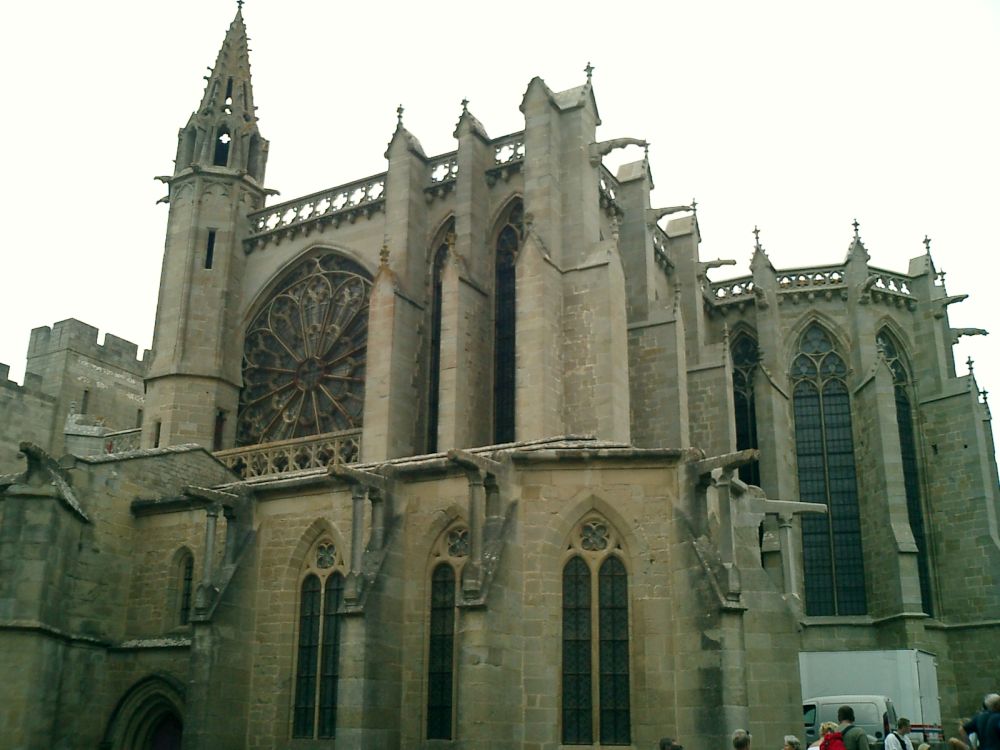
But, I did find one thing that appealed to me: a church dating back to the Middle Ages, now almost inaccessible by foot, having been almost completely buried in what are now back alleys and fully enclosed by hotels:

Achter Lok

In German I call them “Achter Loks” – but probably nobody else does.  In English, the closest translation I could think of might be “the eight train.”

These Re 460 locomotives are a common sight for anyone in Switzerland:

The reason I call them Achter Loks is that all the main design parameters all have to do with the number 8:

  • They have 8 wheels
  • They weigh 80 tons
  • They have around 8000 horsepower

The other cool fact I always remember: when a fully loaded train pulled by one of these locomotives brakes from high speed to a stop, this one braking event uses about the same amount of energy that a family of 4 will spend in one month – and that gives you a good glimpse into just how important electrical energy is for the Swiss Federal Railways.

One cool feature is that these locomotives all have names – and although I don’t like to brag, I started an Internet project to photograph each of the 100+ locomotives.

Home of blue jeans

Just as the villages and towns of central and northern Europe are filled with ancient buildings dating back to the Renaissance, the villages and towns of southern Europe are filled with ancient buildings dating back much further, to the Roman empire.

Here is a Roman building, still in wonderful condition today, at the heart of the town of Nimes in Southern France:

It’s here in this town (Nimes) that the fabric used for blue jeans (denim) was first made famous.

The famous “ossuary swallows of Verdun”

You’ve probably never heard of the world-famous “Ossuary Swallows of Verdun” – but I predict in a generation you will!

Very recently a huge and impressive ossuary was erected on a hilltop in Verdun, as a memorial to the tragic lives that were taken in World War I.  The ossuary looks incredible from a distance:

It also looks incredible close-up:

It looks even more incredible inside – but since it is a religious site I chose not to photograph the inside, which includes a chapel.

But back to the swallows.  The entrance to this huge building is open, and a huge flock of swallows seems to have taken advantage of this as their new home.  As you walk in and out, supersonic sparrows travelling faster than the speed of sound buzz by your head almost too fast for you to see them.

They are easy to spot if you look out over the cemetery,  since the skies are filled with them:

It took me about 30 tries with my mobile phone camera, but last I was able to capture one of these hypersonic birds in flight:

You can see the little fellow racing out of the building, just to the center of left and towards the bottom.