Seven unusual houses near Appenzell

You’ve probably read my post about the artwork of Swiss artist Udo Rondinone, Seven Magic Mountains.

Well, here’s Seven Unusual Houses!

While driving around the beautiful countryside near Appenzell, I spotted a huge field with seven identical houses arranged neatly in a row:

OK, I think I can safely rule out the “seven dwarves retirement community!”

Now if this were in the U.S., particular in a place like Texas, this would be easy to explain. Whole villages and towns (complete with banks and schools and train stations) were created by private companies and offered at low cost to European immigrants, to encourage (or exploit) immigration to new areas.

But here in Switzerland?  This is something I really need to research!

What motivated me to stop and take this snap was not the houses at all, but the rather unusual crucifix – typically they tend to be stone, but this one was gilded:

When blog passions collide

If you’ve spent any time reading my blog, then you’ll know about a few of my blog passions. These are Hidden Canals, erstwhile important public works projects that today are slowly slipping into away from our perception; Great European Cathedrals, of which the greatest are generally in the tiniest towns and villages that no tourists ever visit; and Unknown French Villages, unknown by all but the locals, never visited by tourists, and yet holding amazing treasures.

So you can imagine my joy when I stumbled across this site in Chalon-en-Champagne, no less than a hidden canal, next to a great European cathedral, in an unknown French village.

The Hidden Courtyards of Zürich

Every summer tourists flock to Zürich, the most expensive city in the most expensive country in Europe. And they walk around and they see the sights.

But most of them do so quite unaware of some real wonders that Zürich has to offer, namely, hidden courtyards.

Just off of the Bahnhofstrasse shopping district, you couldn’t be blamed for walking past this opening, hardly glancing inside, and thinking it was a driveway.

But in fact, if you walk through, it is one of Zürich’s best-kept secrets: one of the many, many hidden courtyards, filled with huge trees, park benches, and historic water fountains, some of them dating back to the Middle Ages:

How can wonders be so quickly forgotten?

It amazes me that some incredible things – well known to everyone at the time – are too easily forgotten and left for the archaeologists and accidental discoveries centuries later.

In one of the central plazas in the northern Swiss town of Winterthur you’ll see this:

It looks like a boring picture of a boring plaza, at the corner of which sits strange (but boring`) gray metal object, about the same size and shape as a garbage can.

And that’s what most people probably think that it is.

But they’d be wrong!  In fact, this is an observation portal built above a set of huge underground water cisterns. Apparently, I was told, these water cisterns were only very recently discovered while installing a new water fountain in the plaza.

If you peer down the portal and activate the light switch, it looks like this:

I still haven’t done any research of my own into this topic.  I was told that there were regular wars and fighting during the Middle Ages for as long as there were the Middle Ages. This culminated in a war between the city of Winterthur and the city of Zürich – and these cisterns were created as an emergency defensive measure, deep within the Winterthur city walls, so that the inhabitants could have access to water during times of siege.

When you think of Switzerland, a shortage of drinkable water is the last thing you’re likely to think about – and that shows how different our lives and experiences are today from those that went before us during the Middle Ages.

What other wonders are buried beneath Winterthur, awaiting accidental discovery?

Gabriel in Zürich – The true backstory

If you’ve read my post about Historical Jewry in Zurich, I might have left a few details out. Here’s the “backstory” as told by my father of Uncle Eddy Speaks Up fame:


Gabriel felt uneasy in Zurich at the best of times.  The Swiss have made it clear that he was not welcome. But he was back.  Worse, he was about to enter the old Synagogengasse and he didn’t much care for company. And yet here, in the evening mist, was someone else, pretending to read the plaque that told of the old pogroms there and holding a cell phone camera.

Gabriel’s hand went under the black slicker he wore and gripped the Beretta in the small of his back.  Standing in the shadows was a figure, quite tall and seemingly bald, he held a baseball cap to as to get closer to the plaque that marked the end of the alley. No one went to Synagogengasse, not even Jewish tourists.  Gabriel hoped that this was a coincidence, and that his cover wasn’t blown. No one was supposed to know he was in Zurich.

This was not a time for caution, and against his better judgment he had to move.  He slipped up quietly behind the stranger, pulling the Beretta, and jammed it into his ribs.  “If you want to live”, Gabriel said, “tell me who sent you.”

“Hey, man, quit the gun stuff”, said the stranger.  “I’m Ken, and I live here in Zurich”.  Gabriel’s eyes narrowed: “You have a slightly American accent – Ken.  If that’s your name.  And why take a picture of the Synagogengasse plaque?”

The stranger pushed the Beretta away from his ribs, and said: “the pictures are for my blog, you moron.  I travel all over the region – France, Germany, Italy – take interesting pictures and publish them in my blog.  This is a little known Jewish relic in Zurich and I wanted to see it.   I was trying to read the plaque when you came sneaking up, you jackass”.

Suddenly, it made sense to Gabriel.  “Wait a minute.  Ken —  blog — Zurich.  You’re Mr. Tradecraft’s friend Ken?”   “That’s right”, said Ken, now uneasy at the mention of the seldom-spoken name.   “I’m sorry.”, said Gabriel, “I’ll just slip away quietly and leave you to your reading.  Have you heard from Mr. T, lately?”

Ken looked at him, and made a what-a-dumb-ass-you-are face. “When Mr. T wants you to know where he is, he’ll call you.”

Bubble Architecture – 2

In a recent post I’ve talked about a trend I’ve seen – particularly in France, but France is not alone – to enclose historic buildings in glass facades.  I call it bubble architecture.

If done right, it can compliment the existing architecture.

If done wrong, it can be an ugly eyesore, as this example in Chalons-en-Champagne shows:

In this case, several streets were enclosed in glass and turned into an indoor shopping center.

As global warming continues to slowly increase just under the threshold where it would have triggered immediate reactions from us, humans will slowly begin to adjust their environment in subtle ways. In 50 years, it is likely the entire city center will be enclosed in a dome, and we humans will have barely noticed how this “new normal” will have come into being. Like a frog being slowly boiled in water.


Bulgarian Cathedral

You can’t make a trip to Sofia without seeing this incredible church, the Alexander Nevsky Cathedral:

It’s a fairly modern cathedral, as far as cathedrals go – built around 1870 I think. This was always one of my “jumping off” points for long walks around Sofia, where the ancient and glorious architecture could still be found after hiding for a few generations under Communist neglect. In a generation from now, I predict Sofia will be one of the greatest European cities.

Shimoga and Jog Falls

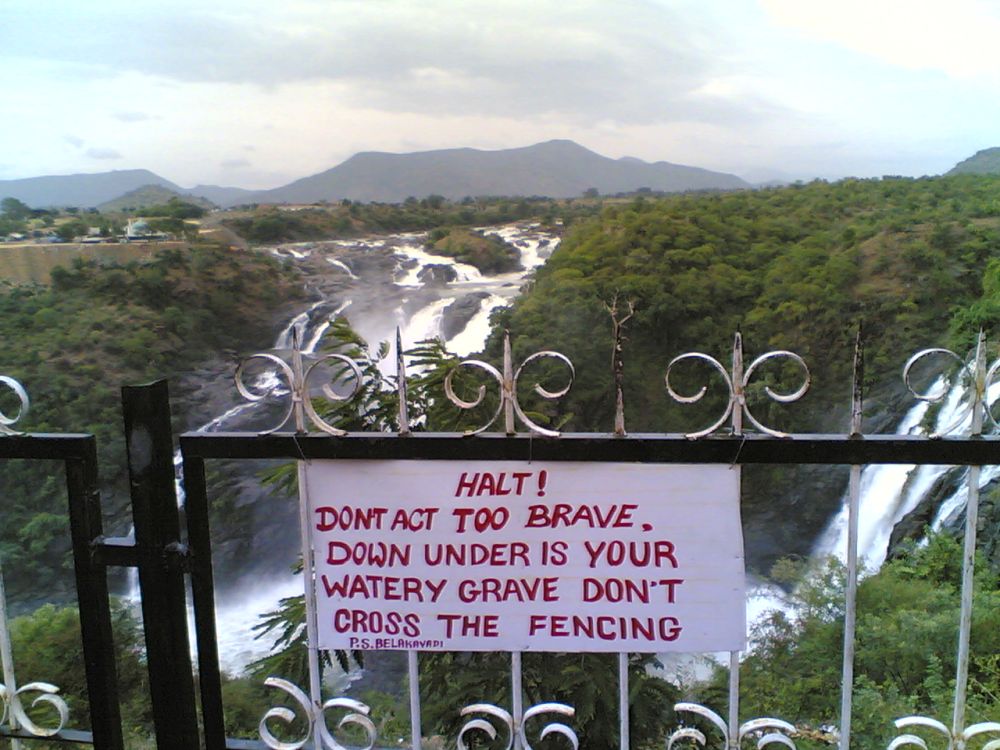
Probably anyone who’s spent enough time in Southern India will wind up here one day – since it is India’s second largest waterfall:

It might be different today – in fact I hope it is different today – but many visitors would climb down the rocks, and I was told a lot of them have died trying to do this.  You can see how treacherous and slipppery the rocks are likely to be:

But as usual, for me the real fun was not seeing the waterfall at all, but rather experiencing all the wonderful Indian villages in Western Ghats in and around the area called Shimoga:

I never took any pictures of the pineapple vendors – but pineapples are grown in this area, which is the first time I’ve ever seen an area where they grow.


Bitche – how can you resist a village with a name like that?

While driving aimlessly across Lorraine I stumbled across a road sign pointing to “Bitche” and I could not help but drive out and see this rural French village:

To me it looked like just about any other small French village – pretty, quiet, quaint.  But then when my eyeballs caught sight of a massive, massive fortress – my head nearly exploded!  This fortress dating back to the 1200’s in this tiny village is almost too huge to really comprehend!

I don’t know exactly how big this “citadel” is . . . but certainly many dozens of football pitches could fit within!

Germans and their Bubbles – 2 of 2

Continuing the series, when I moved to Germany I was surprised at how passionate Germans could be about their bubbles.

This sight of clear glass inspection windows will raise no eyebrows at any petrol station in Germany:

You’like likely to find a big sign with the words Blasenfrei zapfen – which, loosely translated, means: relax, don’t worry. We’ll show you the gas flowing through the line to convince you it contains no bubbles and we are only charging you for gas, not air.

What people have told me: Americans also were concerned about bubbles in their gasoline – and gasoline dispensers in the U.S. had similar means to see the flow of gas.  In the U.S., however, this practice seems to have died out in the 1950’s.

Amazing Bern

Tourists come to Switzerland all the time.  Zürich is a natural location for tourists to see. And it seems hoards of tourists (particularly from India) flock to Lucerne.

But the real gem of Switzerland is not well known outside of Switzerland – it’s not at all visited by many tourists – and I think the locals prefer it that way.

Probably even writing this blog could land me in jail for breaking a carefully guarded Swiss secret. This photo just shows about one tenth of this incredible UNESCO site:

Interestingly, what I find most exciting about this city is not the city itself but the language that the locals speak.  They don’t speak German but rather a very special form of a more advanced, evolved language: Alemanic.  In addition to having many features that other languages could only dream about, Alemanic is hundreds of years more “evolved” than German: meaning that subtle changes in vowels and consonants that occur over the generations have yet to occur in German, but are present in modern day Alemanic.

Most incredible cathedral so far!

This is the late artist M. C. Escher:

And this is one of his lithographs, from 1955, entitled Convex and Concave:

If you think this complicated and impossible, and if you worry whether seeing something like this in real life could make your brain explode . . . then AT ALL COSTS you should avoid the cathedral Notre-Dame-de-Vaux, located in Chalons-en-Champagne, France:

Why should you avoid this?  Because if Escher confuses you, then the inside of this cathedral will make your head explode!

There are plenty of old cathedrals in Europe, but this one is special. It’s on the UNESCO list of world heritage sites. I never took any photographs of the inside . . . but believe me, it has a complexity of architecture that would put Mr. Escher to shame!


Verdun . . . it’s all about the hills

Not a lot of people today know much about Verdun.

Since the 1700’s it was the sight of massive and devastating battles, culminating in the Battle of Verdun in 1916. Around 1 million soldiers were killed in violent combat, at a rate of around 70’000 soldiers per month.  In German, it’s known as the Schlacht um Verdun – in my view more fitting, since the word Schlacht is more than just “battle;” also carries the connotation of slaughter.

The question I’ve always wondered about: why?  What was so special about Verdun?

I only just found out the answer when I recently visited. Here I am on a hill looking north, at the flat region hundreds of meters lower:

The village of Verdun per se has less to do with the reason for the battles here.  Just a few kilometers north of the city of Verdun are hills – high hills – and these hills separate the flat plains in the north from the flat plains in the south.  The difference being: the flat plains in the south lead all the way to Paris.

So . . . anyone trying to invade France (such as the Prussians in 1789, or the Germans in 1916) need to cross these hills.  Over the years and centuries pre-dating WWI the French fortified these hills, with forts and bunkers and tunnels.

(Although its not visible when you visit Verdun, I have read that, at least in the early 1900’s, the French took a great pride in their possession of Verdun.  And that is something that, according to some scholars, the German general Erich von Falkenhayn tried to exploit when he launched his WWI campaign — not strictly to take and control Verdun, but instead to slaughter as many of the French soldiers as he could. There are other scholars who believe this argument was bogus – just his attempt to justify his ineptitude.)


Garbage in Switzerland

After showing how Texans deal with their garbage, I thought it would be fun to show how my apartment building in Switzerland has recently tackled the challenge.

Until a few weeks ago, there were huge containers that we’d throw our garbage bags into:

They were smelly, took up a lot of space, and were an eyesore. It was also a lot of work for the garbage collectors to tip every container into their truck, and to clean up afterwards.

That was a few weeks ago, and this is today:

The garbage is contained in an enormous underground bag.  With a key, you can open the lid and toss in your bags.

Now there are no more smells, no more eyesores, and just a single garbage collector can do the job that previously took three – and do it much faster and cleaner!  It is emptied by a single operator using a remote controlled crane.

Bubble Architecture – 1

There is probably no such thing as bubble architecture, but that’s the term I use to describe it.

Particularly in France you can find many examples of old, historical buildings that are then protected, modernized, and expanded by encasing them in a glass enclosure.  The Gare Centrale of Strasbourg is probably the most famous example – and I’ll post a blog that shows it someday.

And here is another example,

And here is the plaque outside that describes what has now become of the very historical Aubette building, which used to be a military barracks:

Middle Age Church – but you can’t go in!

Here is something truly amazing that is rare to find in Europe: a fabulous church dating back to the Middle Ages, the Vieux St. Vincent – and you can look at it, but you can’t go inside!

It dates back to the 7th century, and it’s located in Macon, France – but you can’t go in!  It seems to be in a rather poor state, and as far as I could tell there was a renovation effort underway.

Historical Jewry in Zürich

I just finished reading a fabulous history book by Riccardo Calimani entitled “The Venetian Ghetto: the history of a persecuted community.”  It makes a single reference on a single page to a Jewish community in the Middle Ages in the city where I live, Zürich.  Curious about this neighborhood, I decided to see what I could find.

It seems almost nothing remains of this area of the city, except a single small alley way named Synagogengasse (or Synagog Alley in German)

And a small placque that describes the street I was on (Froschaugasse) was the center of the Jewish community before a series of pograms decimated the community.

Here’s a close-up of the placque:

I have no intention of translating – it’s abominable to think what happened during the Middle Ages and later periods to follow. There’s still so many things about this period of history I just don’t know – but I find it WONDERFUL that with a bit of Internet surfing and an interest in history, you can easily find places like this.

Coupling Trains – 1

How do you couple train wagons together?  That’s easy: with a coupler!

Here is a modern automatic coupler in use with the Swiss Federal Railways (Schweizerische Bundesbahnen):

Sadly . . . I don’t know what couplers are called in German, and I really don’t feel motivated to find out.

Also sadly . . . I’m afraid I can’t truly understand the complexity of these couplers. As you can see from the photo there appear to be hundreds of small parts that are exposed to dirt and the weather – but I assume in spite of this, it must be the simplest possible design.

But wonderfully . . . I had the privilege of working for the Schweizerische Bundesbahnen and also being in the cabin of a train when the train driver used one of these automatic couplers.  He told me the process is to, quite literally, smash his train into the train to be coupled, being sure to use a maximum speed of less than 1 km / hr.  No other effort from the driver is required; the system is 100% automatic.

The older trains use a manual coupling system that requires someone to climb under the train and connect the wagons manually.  As time permits I’ll post a photo of that system.

Ladies with fruit bowl hats at Westminster Abbey

I tried to enter Westminster Abbey – without success.  The guard informed me the church was closed to the public on that day – and about 5 minutes later a huge entourage of ladies wearing huge hats arrived:

These were not just hats to protect against the rain – these were huge hats that look like that contained whole bowls of fruit on top!

Now, were these royal ladies?  Or maybe just the regular meeting of the “fruit bowl hat enthusiast’s club?”  I guess I’ll never know.  But I do have to say, English ladies do seem to like wearing hats that look like they had huge bowls of fruit on top!