The Nation’s Capital
I recently visited Washington DC, which I had not visited in many years. I thought some areas (particularly north of the White House) seemed much safer and cleaner than I remember. I saw the White House:
And there is a whole building dedicated to the guy on the 5-dollar-bill:
It makes sense he would get his own building, because the guy on the 1-dollar-bill only got a big concrete stick:
The Smithsonian museums are worth seeing. Their Natural History Museum, for example, has tiny little elephants:
Now, this building looks like a spaceship or an attraction at Disneyland, so you could not be blamed for guessing this is in fact a Mormon temple:
Finally, I visited the NSA in Ft. Meade, Maryland. There is an interesting slogan I saw on a T-Shirt for sale in their gift store: “The NSA: the only government agency that actually listens to you.”
In their museum they have a large collection of Enigma machines, an old Cray supercomputer you can sit on, and other stuff:
A real unexpected surprise was to see a real BOMBE machine, which was used to decrypt devices like the Enigma. The UK apparently junked all of their BOMBE machines, so I was not aware that some were still in existence:
We, the adaptable
As I previously reported here and here, during the last crises in Gaza, I took a trip to Jerusalem. On the one hand I wanted to see and experience for myself what life was really like in this country at this time — but on the other hand, I am not completely stupid, and a hotel within rocket distance of Gaza was out of the question for me. I Jerusalem I saw this sign hanging in my hotel:
There was a rocket warning just the day before I arrived, but the local folks I spoke with seemed used to taking this in stride. It’s really quite amazing, and it just to goes show you amazing how adaptable we humans are.
Western Wall
This is the Western Wall, one of Judaism’s holiest sites.
A few things struck me when I visited it. First, it was much smaller than I had expected.
Second, it was interesting to look at the various pilgrims and visitors. Some were tourists, like me. Some were extremely pious people for whom this was a once-in-a-lifetime event. And others seemed to be “regulars” who came here often.
Città di Como
The small town of Como is located on Lake Como in northern Italy, just across the border with Switzerland. With a car it’s less than a three hour drive from Zürich, so while you’ll find some Swiss residents here on the weekend, it is quite surprising you don’t find more of them.
This shot is pretty but not remarkable:
And this snap is also pretty but not remarkable:
But now to compensate this boredom, here are two remarkable things! First, this is a building whose purpose I cannot fathom. The arches seem much too small to bear any weight, so it’s not clear to me what purpose they served. Second, there is a BUG in the content management system I am using. The picture is not rotated in any way, as you’ll see if you click on it. But the media import module in WordPress – for whatever reason – has created a rotated thumbnail!
So, as is the theme for my website, sometimes you can find the most remarkable of things in the least remarkable places!
Hidden canals #2: Canal du Rhône au Rhin
Here’s why I find canals so fascinating: they were massive, transformational public works projects, still visible today, but whose need and impact to society have all but left our cultural awareness.
And here’s why I find hidden canals so fascinating: out-of-sight, out-of-mind. Dismantling sections of a canal, or covering them over, or filling them in, is the the first step in their disappearance from public knowledge and their relegation to archeology. Ask anyone about a hidden canal, and they will tell you they vaguely remember something but usually can’t quite put their finger on what they remember.
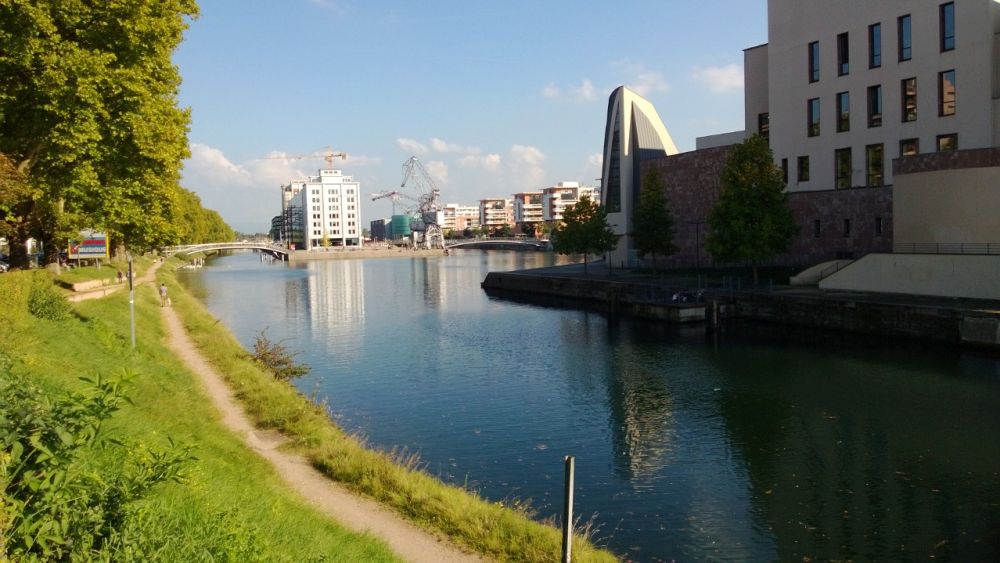
Continuing the series, this is a section of the Canal du Rhône au Rhin in village of Mulhouse, in the eastern part of France:
And here is the bit that is now hidden, covered over by a park and a busstop:
Just to prove a canal is truly hidden here, I simply turn 180-degrees to get this view:
And here is a historical photograph. Next time I get to Mulhouse I’ll have a look if I can find any of these old buildings. But you’ll see immediately from this picture how prominently this canal was incorporated into the landscape architecture : the city was proud the canal ran through it, and the integration (both landscape and cultural) was tight.
Table Top Review: The Kenwood HB724 hand blender review – no ordinary potato masher, this
Continuing the series, is it just me or does everything containing the word “KEN” have extraordinary talent, exquisite design, and unsurpassable quality? At least, the Kenwood HB724 hand blender is no exception.
After boiling some potatoes it was time to put the “Potato Puree” attachment to work.
No ordinary attachment this, it would more aptly be named “potato auger:” it contains a reduction gear and a black plastic paddle, and the potatoes are lifted upwards and pressed through the holes.
Here you can see the potatoes as they are squeezed through the holes, helping to puree them.
Here you can better see the effect of the potatoes angered through the holes:
Finally, although I am not showing it here, cleanup is a snap. The plastic auger blade detaches from the assembly, and you clean everything up with just a gentle rinsing with warm running water.
Overall comments and feedback
The reduction gear ensures the auger blade turns at the perfect speed to puree potatoes. The size of the holes through which the potato puree passes are perfectly designed. And I was pleasantly surprised: this device worked very well with the very small number of potatoes I cooked (some devices really only work when you have a large amount of potatoes).
Was it worth it?
Yes, absolutely!
Negatives & Suggestions to Kenwood for improvement?
Nothing.
Further reviews on this topic needed?
No. I didn’t mention it here because I didn’t use it or describe it above – because I think nobody would believe it – but something happened that I myself can hardly believe. I cooked my potatoes without peeling the skin. After multiple cycles of the potato auger the skins were all filtered out from the potato puree and kept within the auger housing – in effect, the Kenwood acted as a potato skin filter! This is an added bonus – but it is so wonderful, I think it would almost be straining credibility for me to mention this!
Would I do this again?
No fuss no muss – I’d use the Kenwood for freshly mashed potatoes every day of the week and twice on Sundays! Here I want to re-iterate, for the second time, the philosophy of use, or PoU: I kept the Kenwood power unit permanently plugged in and sitting on my kitchen countertop, ready for action. So at a moment’s notice and without any effort at all, I could bring out the attachments I needed.
Reflections of a Valley Guy – Part 5: “Mr. Yee & the Albrae Street–Taiwan Connection”
A guest blog, by Chuck Ritley
Here’s a bit of history: Intel introduced the 16-bit 8086 CPU in 1978. It was a tad expensive, and soon followed by the cheaper 8-bit 8088. These little gadgets put mainframe logic in a tiny, affordable package. And soon garage wizards figured out how to build full computers.
IBM jumped on it and did the world a big favor: they invented “Open Architecture” with the release of the first IBM Personal PC. A simple design, freely publicized, it opened the door to anyone who could assemble: a motherboard with BIOS, expansion slots, and controller chips; an 8088 CPU; some memory; keyboard; monitor; and floppy disks for storing data. No big deal.
The floodgates opened. Everyone who assembled electronics brought out “IBM compatible” PCs: Zeos, Tandy, Compaq, Packard Bell, AMD, Gateway, H-P, Wang, TI, Sanyo, and – of course – Dell.
For the first time, there was a “free market” for computers. Good? Well, almost. Everyone wants to make money, and the industry had a “price point” of about $1000. You could save a few bucks by buying from Dell or Zeos – but only a few. So “IBM clones” were cheaper, but not that much.
This tidal wave rolled over The Valley, and entrepreneurs started “White Boxing”: building clones from parts at discount prices. The heart of the White Boxing “industry” was Albrae Street, a small street of storefront-warehouses combos, like mini strip malls, right near the mud flats of San Francisco Bay.
The local “computer press” (like “Computer Currents”, free at the 7-11) ran huge ads, offering PCs for $700 or so. Still too much for the true geeks who thought “If they can assemble one, then I can, too.” So they descended on the White Boxers, not for PCs – but for parts. I know – I was one of them.
We haunted the warehouses, hunting bargains. And found that even parts could be “cloned”. (Whether or not this was legal is not a priority with geeks.) For example, when you wanted a 5-inch floppy drive, you could buy a Shugart or Memorex (the same as IBM used), OR – – – – you could buy a “knock-off” with no label and manufactured in Taiwan for much less. But, hey, it still worked.
Enter Mr. Yee – who soon became The King of the Bay Area parts empire. Mr. Yee sold full-size clones, with name brand parts, at good prices, and clones with no-name parts at even better prices. His whole extended family worked back in his warehouse, and could assemble a PC in minutes, “burn it in” that night, and you pick it up tomorrow. (I suspect that they all lived back there, too, but parts were cheap, so Immigration can mind its own business.)
Parts – that’s where Mr. Yee shined. Whatever you needed – Mr. Yee had one cheap. No name, no label, but it always worked just fine. Truth be known, this was the beginning of the end for “Made in America”.
I saved up, bought parts for my first PC, and Mr. Yee threw in a copy of DOS and an x86 assembler. A few hours with tools, and it ran. I got a copy of Lotus 123, some utilities, and started on the road to expertise.

A few months later, my son Ken returned from a summer internship at the Oak Ridge National Labs where he had worked on Cray supercomputers, wanted his own computer (not a Cray), and had been saving up. Not impressed that his old man had actually built a PC, Ken preferred one “professionally assembled”, so off to Mr. Yee. Ken went first-class on his order: a full 640K of memory and, as I recall, it was a turbo-chip 8086 which could shift up from its usual 4.7 Hz cycle to a screaming 8.0. The frosting on the cake: a 1200 baud modem.
Those days are gone. Today few users can change a battery. No one has any tools, and help and advice comes by phone from someone in a different country. We used to grow our own food, fix our own cars, sew on our own buttons, and build – and “burn in” – our own computers. Have we evolved? I’m not sure.
This guest blog was submitted by Chuck Ritley, an adjunct professor of computer science with several major universities in the San Antonio area.
Here are the links to the other blogs in this series:
Reflections of a Valley Guy – Part 1: “The Way It Was”
Reflections of a Valley Guy – Part 2: “First Wave of Characters”
Reflections of a Valley Guy – Part 3: “Evolution of the Geek”
Reflections of a Valley Guy – Part 4: “When Giant Frys.com Sold Pork Chops”
Reflections of a Valley Guy – Part 5: “Mr. Yee and the Albrae Street – Taiwan Connection”
Table Top Review: The Kenwood HB724 hand blender review – three types of fresh Italian pesto
Continuing the series, for almost seven years I worked as short-order cook in a cafeteria with service for up to 300 people. When I worked in a professional kitchen, all the equipment and tools we needed were professionally maintained, right at hand, and ready to go. And after using the equipment, we had people whose job it was to clean up. Not so in the home kitchen, where there is limited space, and where I have to do the clean up myself.
So for me, the main challenge of electric kitchen gadgets (like blenders and mixers and juicers) is that it is difficult to obtain a net overall win/win situation: the needed overhead (pulling them out, setting them up, cleaning them up, stowing them) quite often exceeds the pleasure or value or time savings provided by the gadget.
In attempt to rebalance this equation in my favor, I recently purchased a Kenwood HB724 hand blender.
In the coming blog entries, I will give some table top reviews of using my new Kenwood blender, and especially try to answer the question: was it so easy and convenient and effective that I will be using it for this purpose again?
The Kenwood HB724 hand blender makes three types of fresh Italian pesto sauce
What is amazing and unbelievable: the U.S. grows more garlic than any other country, yet fresh, undried garlic (not picked-early-and-dried-out garlic) is not readily available. This is a bulb of succulent, wet, juicy garlic, probably just a few days after being picked from the stalk:
Not yet having been dried, the bulbs are wet, and the skins are wet with the texture of any other fresh vegetable. Interestingly, you peel the garlic just like you’d peel a fresh banana:
Here are the other ingredients, including fresh basel leaves, fresh Parmesan Reggiano cheese, and two types of nuts: pine nuts for a smooth, creamy texture; and cashews for a light, nutty taste. Note the level of the high quality extra virgin olive oil.
And here are the results: I made a sun dried tomato pesto (front center), consisting of just garlic, sun dried tomatoes, olive oil, and chili flakes; a green pesto (right); and a “mixed” pesto (left) that is essentially the green pesto, but with sun dried tomatoes and chili flakes. I made the pesto quite thick, so that I could store it in the refrigerator for several days. Before using, I’ll heat and add more olive oil.
Overall comments and feedback
Having already made orange juice, I was not surprised at the smoothness of the grinding action. But I was pleasantly impressed at how well the addition of extra nuts and garlic into the pesto-in-progress was incorporated, which shows this grinder’s excellent mixing action. What also impressed me on this job was the shape and size of the mixing unit: it is large enough for a sizable portion of pesto, it has a large enough mouth to make it easy to add the ingredients – but it is small and compact enough so that I won’t think twice about using this great device for similar food preparation jobs.
Was it worth it?
Yes, absolutely!
Negatives & Suggestions to Kenwood for improvement?
Nothing.
Further reviews on this topic needed?
Yes. I didn’t mention it here because I didn’t use it, but the mixing bowl comes with a plastic lid. This means you can prepare sauces in the mixing bowl, then simply cover the bowl with the lid and insert it into the refrigerator. I plan to test this feature in up coming recipes.
Would I do this again?
No fuss no muss – I’d use the Kenwood for fresh Italian pesto every day of the week and twice on Sundays! Here I want to mention, for the first time, the philosophy of use, or PoU: I’ll be keeping the Kenwood power unit permanently plugged in and sitting on my kitchen countertop, ready for action. So at a moment’s notice and without any effort at all, I can bring out the specific mixing attachments I need – thus lowering that “effort barrier” that plagues all fancy electric kitchen gadgets and discourages their long-term use (or discouraging them becoming part of your daily cooking system).
Table Top Review: The Kenwood HB724 hand blender review – orange juice
For almost seven years, I worked as short-order cook in a cafeteria with service for up to 300 people. When I worked in a professional kitchen, all the equipment and tools we needed were professionally maintained, right at hand, and ready to go. And after using the equipment, we had people whose job it was to clean up. Not so in the home kitchen, where there is limited space, and where I have to do the clean up myself.
So for me, the main challenge of electric kitchen gadgets (like blenders and mixers and juicers) is that it is difficult to obtain a net overall win/win situation: the needed overhead (pulling them out, setting them up, cleaning them up, stowing them) quite often exceeds the pleasure or value or time savings provided by the gadget.
In attempt to rebalance this equation in my favor, I recently purchased a Kenwood HB724 hand blender.
In the coming blog entries, I will give some table top reviews of using my new Kenwood blender, and especially try to answer the question: was it so easy and convenient and effective that I will be using it for this purpose again?
The Kenwood HB724 hand blender makes orange juice
It will be interesting to see how much juice can be made from one large orange, shown here:

I cut off the peel quickly and roughly, leaving bits for added vitamins and fiber:
Into to the Kenwood blending attachment, and attach the motor wand to the top:
And after about 20 seconds of blending, it makes a full glass!
Overall comments and feedback
The actual grinding was much faster than I expected, I think due to the very well designed blades that cause a very good mixing. Assembling the unit was also easier than expected, because the design is exceptional and all the pieces fit together easily, just by feel. Grinding was easy, because the normal power button and the turbo power button are both very easy to press. And the grinding attachment has a rubber ring that prevents it from sliding on the table top. Pouring from the mixing attachment into a glass was also straightforward and entailed no mess. Cleanup was also easier than I expected, because the plastic is water repellent – just a gentle rinse in the sink was all that was needed.
Was it worth it?
Yes, absolutely!
Negatives & Suggestions to Kenwood for improvement?
Nothing.
Further reviews on this topic needed?
The Kenwood cut through the orange like butter, but oranges are soft. It will be interesting to repeat this recipe with ice or with fruit such as apples that are tougher and may be more difficult to blend.
Would I do this again?
No fuss no muss – I’d use the Kenwood for fresh orange juice every day of the week and twice on Sundays! Since I like pulpy orange juice, the results were delicious. Including cleanup, it hardly required more time to set up and prepare than it would to open a carton of store-bought orange juice.
Hills Like White Elephants
This is the city of Zaragoza, in the region of Spain called Aragon. This is the famous Basilica of Our Lady of the Pillar church, visited by Popes and pilgrims worldwide. It was here that many people think Hemingway drew inspiration for his short story, Hills Like White Elephants.
World’s most dangerous market?
Or at least it could be, if you make the mistake of saying Hola instead of Kiaxo as you enter. For this market is nestled deep within the tough, unforgiving village of Zarautz, deep within the tough, unforgiving Gipuzkoa region of the country of Basque.
The tough, unforgiving people here speak Basque. The Basque language has no known connection with any other European language, and many scholars believe it is descended from what the Neanderthal humans spoke long ago. Filled with hard, explosive sounds such “k” and “x”, it is more appropriate to a people with massive jaws used for crushing nuts. Some words (such as love, or kxxittkxakkatxtaxkta) are used so seldomly they are difficult even for the locals to pronounce; other words (such as softness, compassion, generosity) have no local equivalents.
But I not only survived my visit but also thrived: I bought a wonderful, fresh-smoked sausage from the local market, which unfortunately then required hours to extract the fat from between my teeth. My jaw was never designed for crushing nuts.
Pillar of Moss and Slime – 3
Continuing the series, arguably the world’s oldest and best-known pillar of moss and slime, located in Aix en Provence, shows that my own name for these objects, pillars of moss and slime, is not half bad: this one is officially known as Fontaine Mossue. Interestingly, it is a natural hot water spring that dates back to the Roman times.
Reflections of a Valley Guy – Part 4: “When Giant Frys.com Sold Pork Chops”
A guest blog, by Chuck Ritley
If you’ve been to California you’ve seen one of the Fry’s Super Stores. They’re fun to shop, with a huge selection of electronics. Or maybe you bought from their web site?
Here’s a little story. When I moved my family to The Valley, there was a Fry’s Supermarket less than a mile away – walking distance. Smaller than Safeway or Alpha Beta, with good prices and open 24 hours a day, so groceries were close to home.
Fry’s, a family-owned company, had about 10 of these stores in The Valley, and several brothers and sisters ran it. Back in the 70’s, one of the siblings was also a computer fan, and decided to test out a new section in one Fry’s market, down on the Lawrence Expressway. And this section was to be stocked with stuff for true computer aficionados, in between the grocery aisles. It soon became a favorite destination for all computer nerds.
I heard about this, had to see it, and one Sunday, since we needed stuff for dinner anyway, I loaded the family into the Jeep and headed for the Lawrence Expressway.
Arriving at the “new” Fry’s was pure heaven for a computer nerd. Oh, it was still a true supermarket, but there were aisles full of “stuff”. (Bear in mind there were no ready-made PCs. Whatever you needed, you made.) And Fry’s had bread boards, wiring, chips, power supplies, connectors, memory, resistors, CPUs, and tools. Anything you needed to build your vision. (I never ran into Steve Wozniak, but I have no doubts that he was a frequent visitor.)
The family went separate ways. My wife had a grocery list, my youngest son found the aisle with comic books, while my oldest son started perusing the electronic stuff. (This should have given me a clue that he would soon be drawn to computers.) I marveled at a Zilog Z80 – although I wasn’t quite sure how or what I would do with one. But I did find a memory chip that I needed, and put it in the cart.
We left for the day with enough stuff for an evening barbecue: ground sirloin, buns, salad stuff, gallon of milk, 2 comic books, and a 2 mb memory chip. And then went back to search for my oldest son, still perusing the logic section.
So it was a fun stop. But also a go-to late-evening stop for Valley denizens who were inventing the next generation of electronics. Because it was open 24 hours, at 2 to 3am it was haunted by garage inventors who needed a power supply, bread board, or a handful of connectors. Why wait until the next day? And to fuel these up-all-night pioneers, Fry’s had the junk foods needed to keep them going. Stuff like high-caffeine sodas and Slim Jims. Remember Jolt Cola?
Many years later, I walked into a spanking new Fry’s store near my home. Boring! Just another big PC store. And a boring crowd debating which mouse was better and asking for the free Windows T-shirt.
Much time has passed, and Fry’s has 2 kinds of stores now: food markets and computer bazaars. But I often wonder. What ideas were born in that one old Fry’s on the Lawrence Expressway? The Altair, the Adam, or the PET computers? Did Steve W. come by for solder and a Jolt Cola? Did some guy tired of floppies come up with the Quantum, Maxtor, or WD hard drive? Or the Hayes or 3Com modems? Did Adam Osborne stop by during a long night of development? But like the apricot orchards, it’s long gone.
This guest blog was submitted by Chuck Ritley, an adjunct professor of computer science with several major universities in the San Antonio area.
Here are the links to the other blogs in this series:
Reflections of a Valley Guy – Part 1: “The Way It Was”
Reflections of a Valley Guy – Part 2: “First Wave of Characters”
Reflections of a Valley Guy – Part 3: “Evolution of the Geek”
Reflections of a Valley Guy – Part 4: “When Giant Frys.com Sold Pork Chops”
Reflections of a Valley Guy – Part 5: “Mr. Yee and the Albrae Street – Taiwan Connection”
Two views from Bürkliplatz
Pillar of Moss and Slime – 2
Continuing the series, this pillar of moss and slime is located in Montreux, on the eastern shore of Lake Geneva. As you can see, as far as biotopes go, this one is just getting started. I’ll have to drop by next year and see how it’s changed.
But, there are still plenty of other pillars of moss and slime that I’d like to share as time permits.
Ask Mr. Tradecraft – 1
Dear Mr. Tradecraft, At restaurants, bars and coffee shops I know I should always sit facing the door or window, but what happens when this isn’t possible? Is this rule so important that I should look for a different place to eat or drink? – Beginning Operator Needs Discussion
Dear BOND. I get this question a lot – it might be my most asked question! The short answer is: eat or drink where you like, because where you sit really doesn’t matter.
You have to remember, BOND, we live in a world of CCTV, drones, cell phones, and GPS. So the tradecraft we use today is a lot different than what George Smiley or his contemporaries practiced during their jaunts through East Berlin. There’s what we call the Golden Assumptions of Tradecraft, or GAT-Rules. GAT Rule 1: assume you are under observation, everywhere, all the time. GAT Rule 2: assume that if they want you dead, you’re dead.
Now, BOND, the only thing you’ll likely accomplish by looking for a special seat is to send off those oh-so-subtle body language signals that might be picked up by innocent non-combatants such as waitresses or passers-by. That can only complicate the successful completion of your mission. No, BOND, your best course of action is to assume you are being watched, and rely on your heightened senses and quick reflexes to deal with any eventuality that may come along.
So, BOND, just relax and find a good spot to enjoy your meal. Because in our business, you never know if it will be your last.
Note from Ken: After many decades, Mr. Tradecraft remains a much-sought-after operator for the most demanding contracts with governments, corporations, and private parties alike. He has over 30 years of international field experience that span the whole spectrum of clandestine services, from cut-outs, snatch-and-grabs, bag jobs, surveillance, to wet work — much of it spent in red zones. His retirement increasingly near, Ask Mr. Tradecraft is the pro bono way he gives back to the community. If you’d like to ask him a question, please submit it to Ken – but due to obvious reasons there may be a wait of many months before he can respond to your question.
Reflections of a Valley Guy – Part 3: “Evolution of the Geek”
A guest blog, by Chuck Ritley
We think we know what “geek” means. Wrong! We believe anyone who downloads “apps” to a pad or tab is a geek. Or kids who download free “hacks” (posted by genuine hackers) are hackers. Wrong again.
Geek-dom is an evolution. When I traveled and wrote about The Valley – and when I moved there with my family – I met the real thing: folks who invented geek-dom. Here are some of them. (Yes, I have changed names and identities.)
The Ice Cream Man: I noticed this at a software development facility – every day at 2 o’clock, an ice cream truck rolled into the parking lot and a mob of programmers met it like a “Star Wars” opening. Curious after he left, I strolled through the coding department – and discovered the engine that drove operating system development. Windows were open and the air was fogged and pungent. In a minute, I was pretty high myself. “Okay”, I thought, “now I know why I have trouble reading code.” Argue if you will, but the OS always worked just fine. When I visited similar spots, guess what — an Ice Cream Man.
Today, we have a DEA. Because of that, I think OS’s don’t work as well (Microsoft sends hundreds of patches a week). That’s because the Ice Cream men are gone.
Beatrice the Micro-coder: not many of us micro-code. Yes, we write programs, high or low level, forgetting that control chips are also programmed. Chips and controllers have tiny programs supplying logic. Compact stuff, this is written in languages close to pure binary. Even X-86 hotshots are stumped.
Beatrice was the star. She thought in binary. I can’t verify this, but it must be so because she rarely conversed with her fellow beings, except for one-word answers. But all of her controllers worked.
Being a star, she could be odd. She never wore shoes – summer or winter, only seemed to have one outfit and – this is a guess – only bathed in months without an “R” in them. (A good reason for limiting conversations.) She also brought pets to work – sometimes cats or strange creatures.
Gregory the CPU Genius: multi-degreed from Cal Tech, he was a true logic genius. He designed internal CPU logic and, like Beatrice, seemed to think in binary. I say “seemed” because he rarely, if ever, spoke. (There being no verbal equivalent for “XOR”.) In engineering meetings he scribbled notes, and silently passed them to the engineering director. If he scribbled a lot when you spoke, you were probably wrong.
His daily dress was in Hong-Kong casual style, with black smock and cloth slippers. I never saw the slippers wet, so he didn’t go out on rainy days. He might have lived in his office.
That said, here’s how to recognize a genuine geek:
- They don’t brag – having no interest in talking with ordinary mortals who can’t understand.
- They don’t wear T-shirts with funny slogans. Those mark pseudo-geeks.
- They can think in binary or assembler. Anything else loses something in translation.
- They often smell bad. Not to be offensive, mind you. Hygiene is just low on their task list.
- They rarely “hack”. Everyone else’s code is child-like – they prefer their own.
- They ignore your new iPad as it’s too damned inefficient and retarded.
- They don’t wear Birkenstocks, leaving them to tree-huggers. Having no logic, trees are boring.
This guest blog was submitted by Chuck Ritley, an adjunct professor of computer science with several major universities in the San Antonio area.
Here are the links to the other blogs in this series:
Reflections of a Valley Guy – Part 1: “The Way It Was”
Reflections of a Valley Guy – Part 2: “First Wave of Characters”
Reflections of a Valley Guy – Part 3: “Evolution of the Geek”
Reflections of a Valley Guy – Part 4: “When Giant Frys.com Sold Pork Chops”
Reflections of a Valley Guy – Part 5: “Mr. Yee and the Albrae Street – Taiwan Connection”
Zibelemärit: the most strange and unusual market you’ll ever see!
The Zibilemärit is held on the fourth Monday of every November. It is a huge, world-class, one-day-only street market in the UNESCO city of Bern, Switzerland. What is so unusual about the market: it opens at 3:00 AM, by 4:00 AM the market is already full of many thousands of visitors, transported here from all over Switzerland by special trains that the Swiss Federal Railways schedule.
And aside from beer and wine, the only product that is sold at the dozens and dozens of stands and vendors: onions and garlic. The best part is all the hot food you can eat: garlic soup, onion soup, garlic bread, onion cookies, you-name-it-with-garlic-and-onion!
The history of the market dates back over 650 years: after a fire destroyed much of Bern, the villagers in the neighboring village of Freibourg volunteered to help rebuild the city. In exchange for this kindness, the Fribourgers were allowed to sell their goods in Bern, free of taxes.
Dominus Flevit: X marks the spot, but which spot?
No – the “x” does not mark the golden dome of the famous Dome of the Rock.
Surprisingly, the most interesting feature of the Church of Dominus Flevit on the Mount of Olives in Jerusalem is not very well known: the nave does not point east, but rather it is perfectly situated so that the cross in the window points exactly at the Church of the Holy Sepulcher.
When rainbows collide
Here’s something you don’t see every day: almost every rainbow attribute in just one photograph, taken just outside my apartment on Lake Thun, in Switzerland. Clearly visible are a primary rainbow, a secondary rainbow, supernumerary rainbows, a reflected rainbow – as well as two clear dark areas known as Alexander’s bands. The region between the secondary and reflected rainbow is especially dark, and that is very rare to observe.
Reflections of a Valley Guy – Part 2: “The First Wave of Characters”
A guest blog, by Chuck Ritley
TV gigs like “60 Minutes” show life in The Valley today. Everyone chuckles at bearded Google programmers with bicycles by their desks, environmentally correct sandals, and the engineering gang drinking macrobiotic smoothies.
But these are kids! Newcomers! Freshmen! Squatters writing game code for adolescents in an arena whose history they don’t comprehend. The Valley is an arena, an arena built on blood and grit, by a bunch of tough, smart, future-seeing characters, not afraid to get their hands dirty. They took apricot orchards and turned them into the electronics industry.
The 70s: I was a mainframe systems engineer turned journalist, covering the computer industry for a publishing house. New companies sprung up: DEC, General Automation, Microdata, Qantel, Basic Four, Four/Phase, Nixdorf, Lockheed, NCR – and more. I wrote about them, and I was welcomed in their offices. And most were in The Valley.
I had a great opportunity to meet some of these characters who shaped the industry. Were they my pals? A couple of them became that. But mostly I’m just pleased to say I met them.
Regis McKenna – You never heard of him? But you know Apple, Intel, Compaq, Microsoft, Intel, and Lotus. Regis is a marketing and advertising genius. Neat inventions need a market. Regis made Apple and Microsoft household words. (Bill G and the 2 Steves had ideas – Regis sold them.) I met him at his office in Palo Alto, trying to sell ads in our magazines. We didn’t. But I had a chance to interview the man who knew where the computer industry could go and HOW to get it there. He was generous about sharing his vision. I doubt he remembers me – but it I’ll remember him.
Gary Kildall – he never bought an ad from us. But Dr. Kildall did two critical things that made the whole industry possible: he invented the BIOS – Basic Input Output System. (It boots up your PC.) Then, he invented the Operating System. The first was CP/M, the forerunner of DOS. Companies as big as IBM used CP/M. And Dr. Kildall invented it in his garage.
Dick Pick – CP/M and DOS were ground-breakers, but only geeks like me understood them. Dick created a full operating system called PICK (still in use today) that looked like – well, English. No weird codes, and programmers could use: add, subtract, write, compare, input, and print. We never did sell an ad to Microdata, but I’ll remember Dick Pick.
Jim Fensel – Jim knew everyone in The Valley. He ran a small marketing firm, but put together big deals. Software guy needs a hardware guy? Jim made the intro. Someone had a good idea, but couldn’t afford Regis McKenna? Jim knew who to see and get it done. A great find for a writer, and any time I needed a story, Jim knew of one. I came to rely on his tips and we became pals. In fact, every few years, we’d get together on something. We even put together a product deal about 20 years after I had met him. Sadly, I’ve lost touch. Life works like that. But somewhere in The Valley, Jim is putting together a deal.
Doug Baker – a Canadian hockey player who moved South, Doug was a true visionary. He knew computers were useless without programs, and that business programs needed to be so generic that any company could use one. He worked as CEO of a little company called Basic/Four (now the giant MAI Basic Four) in Orange County, took small Z80-based systems, added an OS, and directed development of a set of universal business functions, written in BASIC, that most companies need. And – Wow! – up to 4 users could work simultaneously. Result: the “turnkey” system. A rush of competitors started doing it too – and this was the way the industry went. I was fortunate to work for Doug in later years and I learned this – if Douglas K. Baker said “here’s where it’s going”, that IS where it went.
There were so many more: engineers, programmers, marketing guys, promo guys – all builders. Guys like: Al Cosentino at MAI, Harry LeClair at Tab Products, Adam Osborne, Don Schnitter, Gene Sylvester, Jerry Cullen, Bo Frederickson, Noel Kyle, Mike Dakis, Dallas Talley, Jim LeBuff, – my memory is over-flowing. I’m the richer for having met them. They built the foundation, they made it happen, they were the first. Google, Facebook, Twitter, and the other kids – they owe these pioneers a debt they can never pay.
This guest blog was submitted by Chuck Ritley, an adjunct professor of computer science with several major universities in the San Antonio area.
Here are the links to the other blogs in this series:
Reflections of a Valley Guy – Part 1: “The Way It Was”
Reflections of a Valley Guy – Part 2: “First Wave of Characters”
Reflections of a Valley Guy – Part 3: “Evolution of the Geek”
Reflections of a Valley Guy – Part 4: “When Giant Frys.com Sold Pork Chops”
Reflections of a Valley Guy – Part 5: “Mr. Yee and the Albrae Street – Taiwan Connection”
Reflections of a Valley Guy – Part I: “The Way it Was”
A guest blog, by Chuck Ritley
Few people know this: Silicon Valley wasn’t always its name. Nope. It used to be: “The Valley of The Heart’s Delight”. Nothing to do with printed circuits, web pages, iMacs, Google, or the Cloud. No – it was the apricot capital of the world.
I moved there in the 70’s, with my family, just when it was slowly acquiring that new appendage – Silicon Valley.
Until Hewlett and Packard started doing electrical things in their garage in Palo Alto, the Valley was a giant apricot orchard. You see, the Valley is a bowl, surrounded by the Santa Clara Mountains on south and east, and the Santa Cruz Mountains on the west. While San Francisco, 50 miles north, is cold and foggy, the Valley, protected all year long by the hills, is 20 degrees warmer than SFO, and sunny – in short, the perfect apricot climate.
Ringed around downtown San Jose, the Valley’s hub, companies like Dole, Libby, and Heart’s Delight had huge canneries. Empty 6 months of the year, during the summer and fall when the ‘cots were ripening, they came alive. With the harvest, thousands of migrant workers came in for the picking. The canning and packing was done by mostly local help who worked part time for those months of the year. And the factories spewed out train loads of canned, dried, preserved and juiced apricots.
In the spring, the Valley was beautiful. The trees started blooming, and everywhere you looked there were gorgeous blossoms. Places were named after them: Blossom Hill Road, Old Orchard Drive, and even a town: Blossom Hill. It was odd driving the roads and even the expressways. Here would be a tract of houses, and there a huge apricot orchard. Even the streets in the housing developments were often lined with apricot trees, making for a slippery walk when they were falling.
But – Wow – what a wonderful place to be in the spring. We lived at the far north end of the Valley, but close enough to enjoy it all.
How many apricots? I have no clue. But I do know that a few miles from my home, on the mud flats of San Francisco Bay, there was a charcoal factory. I couldn’t figure that out. Why build a charcoal factory where there aren’t any forests? Well, next time you eat an apricot, notice that half of it is in the seed. Little fruit, great big seed.
So, if you ship out 100 tons of canned apricots today, what do you also have? 100 tons of apricot seeds. You can’t eat them. Can’t throw them out, else the Valley would be awash in pits 3 feet deep. So – since they’re fiber – you dry them out, roast them, burn them in a kiln, and press them into charcoal briquettes. And, you need a giant factory down on the mud flats to do it. Here’s a fact: for every pound of apricots, half a pound of charcoal. But then no one really wanted it known as “Charcoal Valley”. (Sound like a bluegrass song title?) So the factory sat a few miles north on the mud flats in Alameda County, and garden of beauty remained beautiful.
But like the Eden of the Book of Genesis, big changes were afoot. Man was coming. Binary man, AC/DC man, silicon man, logical man, and program man. They were on the way and nothing could halt the tide.
This guest blog was submitted by Chuck Ritley, an adjunct professor of computer science with several major universities in the San Antonio area.
Here are the links to the other blogs in this series:
Reflections of a Valley Guy – Part 1: “The Way It Was”
Reflections of a Valley Guy – Part 2: “First Wave of Characters”
Reflections of a Valley Guy – Part 3: “Evolution of the Geek”
Reflections of a Valley Guy – Part 4: “When Giant Frys.com Sold Pork Chops”
Reflections of a Valley Guy – Part 5: “Mr. Yee and the Albrae Street – Taiwan Connection”
Pillar of moss and slime – 1
If anyone knows what these things are really called, please let me know. I call them “pillars of moss and slime.” It is a column over which water slowly and continuously trickles. And because of this, the column is host to a variety of natural molds, slimes, algae, moss, and grass – growing in different areas on the column, depending on the ambient light, wind direction, and time of year.
This pillar of moss and slime is located in Bern. I’ve seen similar structures scattered throughout western Switzerland (Bern, Zürich, Lausanne, Geneva, Montreux) as well as southern France. I’ll post further pictures as time permits.
Bluegrass Beans
The Bluegrass Beans on October 10 at Sybille and Rolf Menzi’s Western saloon in Rottenswil. These guys are not merely good; they are seriously good.